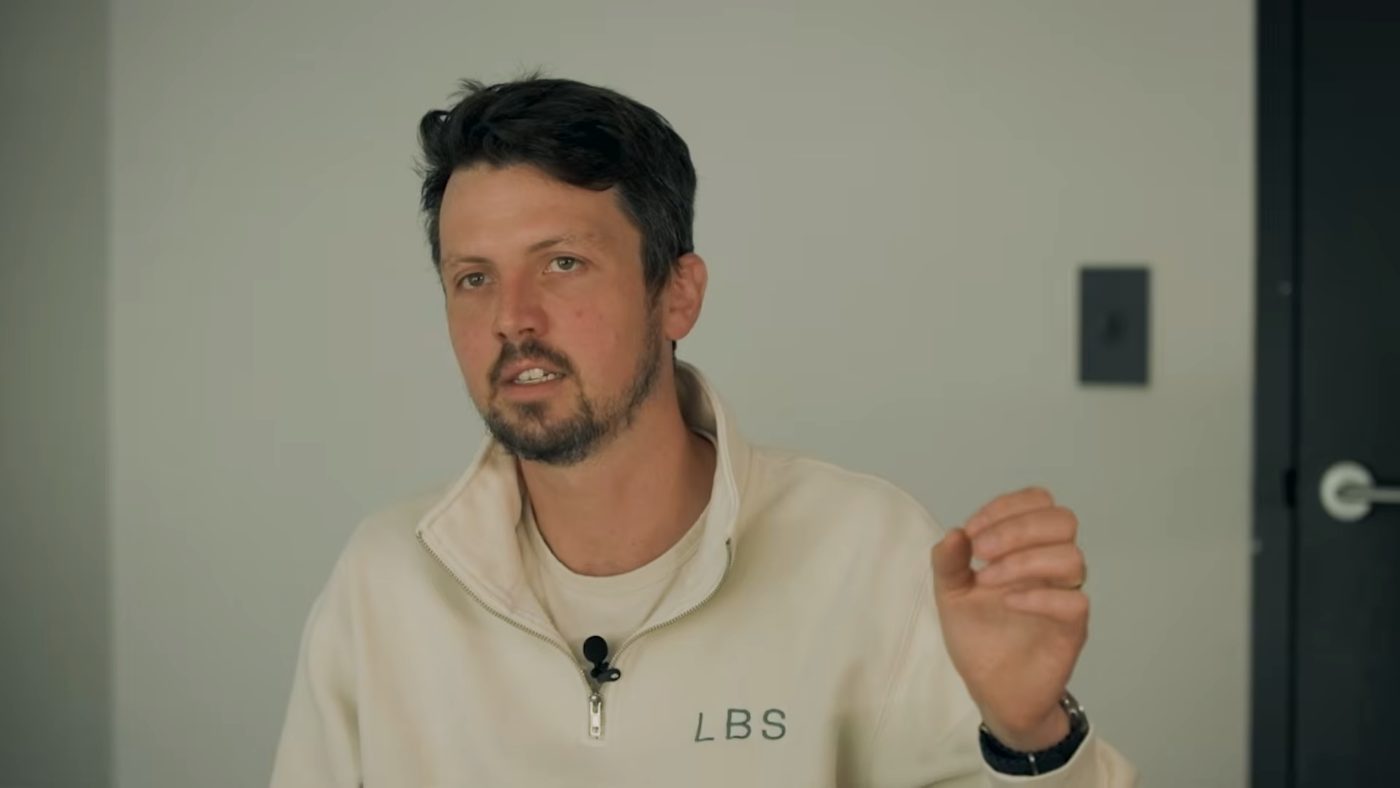
Managing director and co-founder, Living Building Solutions
Started LBS at 28 from a tiny unit and a backyard shed. Took six months off the tools to crack a new building code before anyone else. Turned 45 minutes of talking about cars into 330 jobs in a month. Built about 70% of South Australia's residential energy compliance market. Then walked away from private equity at the ninth hour.
Episode 0232 levels64 site notes for business owners80 min interview
In this episode of Deals & Reveals, Josh Mollison takes us through building Living Building Solutions (LBS), the Adelaide sustainability consultancy he co-founded in 2017. He talks about business the way an energy assessor talks about a house: what it's built on, where it leaks, and what it costs to run.
We open near the end, at the moment Josh walked away from a private equity deal. Then we go back to the start and follow the interview in order. The building on the left goes up as you read.
Site notes pull out the ideas a business owner can take straight back to work. They start amber and turn green once you've passed them, and the stars in the top bar fill as you go. Every note is collected in the as-built report at the end.
Level 01
The ninth hour
The meeting where a private equity deal ended.
The deal was months deep. A private equity firm was in due diligence on the business Josh Mollison had started from a tiny unit in Payneham, with lawyers on both sides of the table.
Josh was already one foot out the door. Then, in a meeting with both sides' lawyers, the buyer's lawyer, an older man, spoke down to LBS's lawyer, a younger woman Josh describes as very impressive.
“That's just not me. I'm not going to sit and tolerate that.”
Josh Mollison
He walked out, rang the buyer and told them LBS was putting the deal on ice. Not the eleventh hour, he says. Maybe the ninth.
4approaches in 12 to 18 months
6–9months of due diligence with one buyer
~40%growth since, according to Oliver
“The big deciding factor for me was people.”
Josh Mollison
To see why a founder would turn down private equity over the way one lawyer spoke to another, you have to go back to how LBS started, and the kind of business Josh set out to build.
Level 02
Disorganised chaos, calm on the surface
Who Josh is, and the elevator pitch he says he's bad at.
Josh Mollison describes himself as relaxed. Not much fazes him. Inside, he says, it's closer to disorganised chaos than organised chaos.
Early in his career he saw that as a weakness. Now he thinks it's a strength: he can be doing a million things at once and still appear calm. Reading the run sheet before recording, he admitted his elevator pitch was poor, which he finds funny given he's the one growing the business.
“I'm a people person. I'm not a salesman. We have a product that people need, not necessarily what they want, so sales is easy.”
Josh Mollison
Then he gave the pitch anyway. LBS is a team of sustainability consultants for the building sector, working on a project from start to finish.
Concept and schematicSustainability reports to support planning applications.
DesignRegulation energy reports, plus holistic sustainability ratings on large buildings.
Post-constructionA testing team on site, measuring air leakage to check the building performs as designed.
The hosts' verdict: not bad at all.
Level 03
Talk to your barista
The coffee order that became a leadership rule.
Asked what has driven the growth, Josh points to being a real person. Too many businesses hide behind formality. He would rather break down the barriers and build a connection.
“People want to deal with people. They'll buy into a brand later. They buy into a person.”
Josh Mollison
The rule has a source: his wife, Ellen. Early in their relationship, at a coffee shop, Josh rattled off his order. Ellen, who knew the barista personally, asked him why he was being so rude.
He now calls it “talk to your barista”. Whether someone is the postman, a managing director or a new graduate, form a connection and treat them equally. Josh makes a point of learning what his staff are doing outside work and where they want to grow.
“My industry in particular, there's way too much management, there's way too much over-engineering, there's way too much structure, and people just feel like a cog.”
Josh Mollison
What Josh sees in the industry
Too much management
Over-engineering and structure
Micromanagement and checkpoints
People who feel like a cog
What LBS does instead
Informal communication
Invest in everyone equally, graduates included
Know what staff do outside work
Empower people to be part of something
Growth makes this harder, and processes and systems are unavoidable. But Josh says this authenticity is the thing he never wants to lose. If he lost it, he would question what he was doing.
Level 04
Three founders, three temperaments
Very different people, one direction.
LBS has three directors, and they're very different. They butt heads, but Josh sees the mix as a strength.
The optimistJosh: glass half full, the risk taker who always sees the positive outcome.
The scepticA director who is very technical, process-based and glass half empty.
The growerA director who is very growth-focused, and also process-based.
They were mates first, which gives them a common goal, and all three share an informal approach.
Strategy is where it gets harder now the business is bigger. The directors are at different stages of life, and one is older and looking towards retirement. That has brought more tension over direction, but Josh describes the journey overall as smooth.
Level 05
The agreement read in the car
Why LBS ended up with one figurehead.
“First time we read it, I'm 28 years old. I'm reading this pretending I understand it.”
Josh Mollison
That was the shareholders' agreement, read in the car on the way to a snow trip in Victoria. Josh says it sums up the naivety they started with.
They were very good at the work, and not necessarily good at running a business or the legal side. Without a sound document, conflict was hard to resolve when it came. As the problem solver of the three, Josh usually ended up as the peacemaker in the middle.
2017Shareholders' agreement read, barely, on the way to the snow.
Early yearsMinimal conflict, but no structured fallback when it happens. Josh mediates.
Around 2023The directors decide they need one direction and one figurehead, and vote Josh in as managing director.
The three still operate as equals. But staff now have one point of contact, conflict has a route to resolution, and the other two directors can focus on their craft.
“I think we undervalued that a lot: three cooks in the kitchen.”
Josh Mollison
Level 06
The U-turn
The morning Josh drove to work and didn't arrive.
One morning, driving to work, Josh reached the right turn into the lane by his office and did a U-turn instead.
He drove home, wrote a letter of resignation and calmly handed it in the next morning. Getting there had taken a few years.
UniversityStudied in Queensland, loved it, moved back to Adelaide.
Large engineering firmA job by default. Surviving, not thriving. Made redundant, and he says rightly so.
Mid-tier firmJoined at the start of its growth. Learnt, grew and progressed quickly.
Senior roleCopied the conflict he saw above him: directive, micromanaging.
The laneU-turn, resignation letter, gone.
“I didn't really know what I wanted out of work … and probably wasn't a very good employee, to be honest.”
Josh Mollison
The management style he picked up didn't match the empathetic, patient person he was outside the office. As the culture became more toxic, it stopped making sense.
Level 07
Phone calls by the pyramids
Time to reflect, then proof of demand.
Josh says he always knew he'd start something. First he travelled through Egypt and Jordan for two or three months, and asked himself some questions.
Do I change careers entirely?
What didn't I like about the firms I worked for?
If I started something, what would it look like, and what would my values be?
Meanwhile, his phone kept ringing. People from his old work wanted to know where he was, because nobody knew what was going on and someone needed to come back and fix things.
“Okay, there's a demand there for me and the service that I can offer.”
Josh Mollison
He reconnected with a former co-worker, Matt, who was getting the same calls. Both were 28. They decided to give it a crack. Work came in so quickly that it arrived before they understood insurances and the other things a business needs.
Level 08
The accountant and the shed
Getting the basics right, and the plan that went in a drawer.
Early on, the founders met their accountant, Adrian Belperio, who still looks after Josh. Josh says he has never worked with anyone more kind or generous with his time.
StructureAdrian set up the trusts and business structure from day one.
Josh's officeA tiny unit in Payneham.
Matt's officeA shed at North Haven, with twin baby daughters in the house, a rug and a blower heater.
The planWritten, then put in a drawer and not looked at again for a long time.
The two lived on the phone to each other, often in the middle of the night. With the structure handled, they could spend their time on what they were good at.
Level 09
Sit next to someone ahead of you
The office the founders couldn't afford.
Through a mutual friend, they met James, a fire engineer with an office in Kent Town. His business was three or four years ahead of theirs.
Josh describes him as relaxed on the surface, a genius underneath, and captivating.
“We couldn't really afford it at the time, but we were like, we need to be around this person.”
Josh Mollison
They moved into his office anyway. Josh credits it with making LBS more professional and giving the founders a network to grow with. James became a mentor and a dear friend, and he'll come up again.
Level 10
The third partner walks in
How Mark joined, and how the founders cut up the pie.
A year in, Josh and Matt still hadn't told their friend Mark what they were doing. He was at another firm, and Josh hated keeping it from him. So they arranged a lunch.
Mark sat down and announced he'd quit a few weeks earlier. That broke the ice. He spent a few months on the east coast in his vintage car, came back to Adelaide and said: let's do this.
Start-up capitalJosh and Matt each put money in, plus a business grant.
The dealIf they weren't making money after 12 months, they'd go back to jobs.
Mark's stakeGifted by Josh, on trust, rather than bought.
The splitAgreed informally around a table, with Adrian advising.
Capital sinceNone. The costs are mainly wages, rent and insurance.
Josh knew they weren't going back to jobs. Matt, with twin daughters at home, was taking the bigger risk.
“That shareholding is worth a lot, and I don't regret a thing gifting it to him. He's returned that, undoubtedly.”
Josh Mollison
Mark brought sales ability and experience. He's older, had scaled businesses before, and gave a young technical founder credibility in meetings full of middle-aged men. Josh thinks they'd have lost some clients without that duo.
Josh on gifting Mark his stake: “I don't regret a thing.”
Level 11
The biggest opportunity and the biggest risk
Six months off the tools before a new building code.
LBS started in 2017 and projects came in straight away. Mark joined in 2018. About six months before COVID it made its first hire, taking the team to four. Then a new building code was on its way, with big changes in it.
“I always refer to it as: this is our biggest opportunity and this is our biggest risk. And at the time, we didn't have a lot to lose.”
Josh Mollison
¼of LBS's billable capacity, taken off the books for six months so Josh could work out the new code
That put a lot of stress on the other two directors and the first employee. Josh spent the time developing LBS's approach to the new code. At industry information sessions, he realised nobody else knew how they would handle it.
Level 12
Iteration ten
The people nobody talked to.
In the building approvals process, a certifier signs off on everything at the end. Josh noticed that nobody actually goes and talks to them.
“So we took our new method, we took our new report to all of these certifiers and went, tear it apart. Tell me what you love. Tell me what you hate.”
Josh Mollison
Those conversations happened in boardrooms, at certifiers' houses and in pubs, and relationships formed. Each round of feedback went back into the report.
Competitors on code day
Showing certifiers their report for the first time
Reports torn apart
Builders' systems breaking
LBS on code day
Report on something like iteration ten
Already vetted by every certifier who might see it
Certifiers telling builders: go and see LBS
“In these large volume builders, you break the system, you're out.”
Josh Mollison
When builders asked their certifier what to do about energy, the answer was LBS.
Level 13
Seven hires and 3 am golf balls
Growth that went nuts overnight.
Josh calls the code change the biggest win in LBS's history. With COVID unfolding, the business could have battened down the hatches. Instead, it went nuts overnight.
7–8hires in six to nine months, most of them mates or people the team knew
One was the first employee's best mate, who is now LBS's ESD manager, seven years later. LBS hired on culture. The work isn't super complicated, Josh says: give people the right training and tools, make it feel like home, and they'll succeed and stay. It didn't use Seek or recruiters until about the sixth or seventh hire.
“If you asked our first couple of employees now what it was like in the early days, they would say it was chaos. It was fun.”
Josh Mollison
For about 18 months the three directors worked all day, every day. Josh would roll into the office at 3 am, chip golf balls with James for 40 minutes, then work in the dark with dubstep playing until the first employee arrived at seven.
Level 14
45 minutes of cars, 330 jobs
The meeting that proved LBS was in.
LBS went to meet a large builder and spent 45 minutes talking about cars. They barely discussed the service.
Josh worked out in the first ten minutes that the builder already knew what LBS could do and didn't care. He wanted to know whether he could deal with these people every day, and whether a problem would get solved when he called. After a quick talk about pricing, he promised 30 jobs that month.
“By the time we got back to the office, we had those 30 jobs.”
Josh Mollison
45 mintalking about cars
30jobs promised for the month
330jobs actually sent that month, on a three-day turnaround
Josh remembers the reaction back at the office in a word that won't go on this page. That volume gave LBS the client retention, and the confidence, to hire and start building systems.
Josh on the builder who sent 330 jobs in a month
Level 15
Cash flow and payroll tax
What keeps an owner up at night, and what doesn't.
Asked whether a wage bill for 30-odd staff keeps him up at night, Josh says it's more a level of consciousness than lost sleep.
Big clientsGood payers once you're in their system, often on 90-day terms. Painful for the first 90 days, then rinse and repeat.
Small clientsHarder. “Oh, I didn't see your email.” Yes, you did.
Bad debtsBarely any written off, though LBS has been through periods of struggling to get paid.
Wages are now most of LBS's overheads, which brings Josh to payroll tax.
“I'm employing more people. I'm paying them more. I want to keep paying them more … and you're going to hit me with what is essentially someone's wage.”
Josh Mollison
The hosts noted that almost every founder on the show has raised the same frustration.
Level 16
Red tape and the housing crisis
Josh's view of the approvals system.
Asked what he would tell a politician, Josh goes straight to building approvals and planning. They're slow, and he would privatise the approvals process.
What slows it down
Civil works that take three years
A different framework, people and agenda at every council
Approval risk that keeps lenders away from big towers
What works
Rezoning and concessions
Changes to Adelaide's height limits
A thorough government design review that sees through greenwash
South Australia's housing supply has been well below demand for a long time, he says, and announcing new housing doesn't fix that. Many of the towers going up are funded by Adelaide developers with their own capital, not big eastern seaboard players.
“If there was a bit more structure of guaranteed approvals, you can get funding.”
Josh Mollison
Level 17
What LBS actually does
Three services, a testing team and three building codes.
ComplianceEnergy reports for anything from a house to a warehouse, kindergarten or tower. LBS produces 10,000 to 12,000 a year, mostly residential, with a couple of thousand commercial.
PlanningSustainability reports that help a development get endorsed, written early, when sustainability has a seat at the table.
RatingsBenchmarking buildings against market-leading sustainability tools such as Green Star.
TestingOn site, with equipment, measuring how much a building leaks air, which is directly linked to its energy use.
“You've got 70% of the compliance market here in SA. That doesn't happen by chance.”
Oliver Ciancio
~70%Josh's estimate of LBS's share of the South Australian residential compliance market
In Western Australia, LBS works with a few large players that Josh describes as very loyal, and it's growing on the east coast. A national body writes the building code framework and each state decides what to adopt, so LBS works across about three versions of the code at once.
AI helps. LBS is developing its own systems, encourages staff to use AI to draft and check work instead of spending five hours on it, and uses it to look up council rules interstate. Its reports rarely attract requests for information, which Josh takes as a compliment.
Level 18
Building the barriers
How LBS defends its share.
Josh says competitors have been playing catch-up since the code change, and some now replicate what LBS does. He takes that as a compliment, and as the cue to build barriers.
ConnectionMost of the engineering industry, he says, is poor at client relationships and has stopped visiting people.
Value-addsExtras that help the compliance assessment or a client's branding, which rivals can't easily copy.
TestingBig engineering firms don't have the time or care to offer it. Small players lack the time or know-how.
“They don't go and see people anymore. The Teams meeting … your office is 100 metres away. Let's catch up and talk.”
Josh Mollison
Level 19
Culture at 30, and a Victorian office
Growing without losing the family feel.
Five hundred staff sounds terrifying to Josh. Then again, so did 30 a few years ago.
He enjoys getting good at running a business of eight, then 12, and constantly learning. But at its current size LBS can't be as informal as it was. Larger tenders need systems and processes that tick government boxes, and that brings a rigidity people aren't used to.
Adelaide today26 staff, with dogs in the office, music, table tennis and Nerf guns.
Adelaide ceilingLow to mid 30s before the fun, family feel strains.
VictoriaTwo staff, with four expected soon, after getting recruiting wrong a couple of times.
NextIf Victoria reaches six to ten people, Brisbane, with Olympics infrastructure on the way.
“Our goal at the moment is to replicate what we've built here in Victoria.”
Josh Mollison
Over the next 18 months Josh would like LBS to reach the high 30s to 40 staff, with more of the growth coming from outside compliance.
Level 20
KPIs are a dirty word
How the directors know they're on track.
“KPIs are like a dirty word to me.”
Josh Mollison
LBS does track company KPIs, but Josh doesn't let them trickle down to staff. It's part of the empowerment culture: track things in the background and let people do their work.
The business is simple. Costs are wages, rent, insurance and small overheads, so the budget is generally accurate. Because client retention is high, Josh can more or less predict what the top ten clients will send over 12 months. That's the baseline. The rest is work in progress and pipeline.
Work in progress
Pipeline
On larger projects, LBS aims for a pipeline at least 1.5 times work in progress, with some crude win-rate formulas on top.
Raw numbers are reviewed weekly and reconciled monthly. That's Mark's domain; Josh calls him a calculator.
Level 21
The growth curve
Big jumps, a flat patch, and margins that held.
LBS growth ratingRevenue growth, as stated by Josh
Code year
170%+
Next 2 years
2–3%
~2024
~50%
2026
~37%
Profit margin held, and improved, through each step.
In the code-change year, LBS's third or fourth year of trading, revenue grew more than 170%. Then it flatlined for a couple of years.
“I'd love to say it was by choice. It wasn't. But we'll say it was by choice.”
Josh Mollison
Josh says the pause came at the right time. LBS needed more staff, less dependence on its directors, and systems to keep quality and turnaround times up.
Then came another jump of about 50% around 2024, and about 37% in 2026. LBS held its profit margin through all of it, and improved it, which Josh says is unusual for a consultancy growing from 20 to 50 people. Most of that came from investing in systems to become more efficient, rather than from charging more.
Level 22
Four approaches in 18 months
When private equity came calling.
About two years ago, Josh rang Oliver with news: a private equity firm was interested in buying LBS.
Over 12 to 18 months, LBS was approached four times: by two private equity firms, a large multinational in its space looking to grow into sustainability, and one more. Josh had never considered selling. Maybe one day, at 50.
RetirementOne director was talking about retiring.
ConflictThe directors were having some.
HomeJosh was dealing with pressures in his personal life.
AIWould the business even exist in ten years?
“You start to piece all that together, it becomes a really appealing process.”
Josh Mollison
One firm found LBS bigger than it expected and they parted on good terms. Another wasn't the right match at all. With a third, a private equity firm, LBS went into due diligence: six to nine months and a steep learning curve.
Level 23
Back to the ninth hour
A return to chapter 1: what the deal taught the directors.
The sale process had a side effect. The directors were spending far more time together, because they had to.
Conflict was reconciled, and they came back to the same page on growth. That gave them enough doubt to hit pause. For Josh, though, the deciding factor was how he thought his people would be treated, and the lawyers' meeting from chapter 1 settled it.
LearntA lot more about how companies are valued, and what red flags look like.
DecidedPrivate equity is off the cards for LBS. Mergers might be considered one day.
InsteadReward the team through equity and profit share.
Level 24
A reason to walk in the door
A return to chapter 3: why people come first.
Oliver, who took Josh's first phone call about private equity, thinks walking away was the best thing that could have happened. Since then the three co-founders have come together as a team, and LBS has grown around 40%. Josh agrees the process reminded him why he turns up.
“I don't walk in the door every morning to make money. I walk in the door every morning to be around people.”
Josh Mollison
He admits he had become disconnected from the team. He has started mentoring again, and he credits the team for the growth since: people who feel taken care of, and part of something important.
Level 25
Who fills your battery
Managing stress as an owner.
Does Josh separate work and home? Not consistently, he says, and his wife would agree.
Having two business partners helps a lot. His father-in-law runs a company as sole owner, and Josh can see the difference: with partners who have skin in the game, he can step away knowing the ship will keep going.
At 22, Josh heard a talk by Dandapani, an American entrepreneur who spent ten years as a monk. Most of it went in one ear and out the other, but one idea stuck: your mind is a battery, and people either fill it or drain it.
“You don't need to cut people out. You just don't invest in people that are draining your battery.”
Josh Mollison
Early on he cut people off. Now he focuses on the people who fill it: his wife and daughter, friends and community. To him, family isn't just blood. When he reaches capacity, he runs for an hour or an hour and a half, with no phone and nobody able to reach him.
Level 26
Get over it quickly
Advice for a 28-year-old working 80-hour weeks.
Josh's first tip is to find your people, including informal mentors. He has never asked anyone to be his mentor. He gravitates towards people whose energy he can learn from, as he did with James back in chapter 9.
His second is to get over setbacks quickly: a lost project, a lost client, a bad meeting. It's something he didn't do well at the start.
“It doesn't matter how anxious you are … the outcome is still the same.”
Josh Mollison
For Josh, anxiety and stress take away his appetite for risk, and scaling a business needs risk. He isn't a perfectionist. He's happy doing a good job that doesn't need to be perfect, and says that lets him take more risks and manage stress better.
Level 27
Just right, not the 1%
LBS's commercial approach to sustainability.
The hosts call it the Goldilocks principle. Josh calls it his approach to consulting. Many in the sustainability sector overcomplicate things and push their agendas onto projects and clients.
The 1%
Passive House: the top of the market
Out of most budgets
Can come at the cost of liveability and connection to nature
The 99%
Commercially realistic advice
Reaches far more projects
Bigger total impact
“If I can influence the other 99%, I think that's better from a sustainability point of view.”
Josh Mollison
Firms that push an agenda miss out on work, he says, and some projects end up doing nothing sustainable because it seems unattainable.
Level 28
Barbecue advice for a greener home
What Josh tells friends who are about to build.
Design firstBuy a block you can design a home well for. It can save tens of thousands of dollars in construction.
Fabric nextGood insulation and good glazing.
Then servicesRegulation focuses on the building envelope and largely ignores services. An efficient house with an undersized air conditioner and a poor hot water system misses the point.
Solar and batteriesIn a climate that needs heating and cooling, that's where most of the running-cost savings are.
“Your home essentially becomes a plant that you can just trigger … it becomes an economy rather than an energy saving.”
Josh Mollison
Josh thinks household energy trading is in its infancy, and that people should start thinking of their home almost as a computer.
Level 29
Stay in your lane
The ventures Josh hasn't started, and the one he has.
Oliver often encourages Josh to think about other ventures. LBS's business model is so simple that a lot of other things look high risk by comparison.
DevelopmentWhat 20-year-old Josh wanted. He still does some private builds.
TradesBusinesses AI can't replace, like the air conditioning firm his father-in-law runs.
TurnaroundsConstruction firms with poor cultures that could be fixed.
AcousticsAn acoustic engineering business. Talked about, not started.
TestingThe one he's backing: already part of LBS, but a different business model.
Testing means people on site, equipment and safe work method statements. Mark runs it, and Josh says LBS has comfortably done the most tests in the country each year for the last five years. He expects testing to become compliance for a share of buildings, which would mean vans on the road and a warehouse.
The host's advice to young founders is the same thing Josh has done: get in your lane, get very good at it, then build on it. Josh puts it down to how he works.
“I can get really good at golf if I play three times a week, but if I play twice a year, I'm awful.”
Josh Mollison
Josh on the testing arm he's most excited about
Level 30
On the other side of the table
When Josh would buy a business, and how.
Would LBS buy a firm to get into Brisbane? Not for geography alone. Josh would back LBS to show up, hire the right people, put its systems in and compete.
A good client bookNot just a presence in a new city.
Cross-sellOffer LBS's wider range of services to those clients, lifting revenue 20% to 30% without new clients.
SystemsUse LBS's systems to make the business more efficient and lift profit.
The key personDo they need to stay, can Josh work with them, or are they leaving?
Having been on the sell side, his advice to buyers is to respect the people.
“If they've gotten to this size, they're doing something right … Don't come in and reinvent the wheel.”
Josh Mollison
He has heard of an acquirer in Australia that rolls up firms by installing its own systems and flushing people out, and says staff are walking out the door as a result.
Level 31
The U-turn, revisited
A return to chapter 6.
Hearing about staff walking out on that acquirer, one of the hosts made the connection.
“They're doing that U-turn before they get to work.”
The interviewer
Josh agreed. Big businesses underestimate the people who drive them, he says.
“I don't run this business. It's people.”
Josh Mollison
Level 32
Rapid round
Five questions, short answers.
Bucket listA marathon while his body can still handle it, after a couple of trail half marathons. And structuring his life to be present for his daughter, from teaching her to swim in the ocean to soccer or music.
Best adviceFrom his Scouts days: don't piss into the wind. In other words, don't make things harder than they need to be. And, for weighing up risk: if you don't have a crack, you won't find out.
Read or followThe Barefoot Investor, for anyone young trying to get ahead. As a thinker, Matthew McConaughey; his book Greenlights is on Josh's bedside table.
Dinner guestMcConaughey, or Serena Williams, Josh's number one athlete in history, for staying at the top of her game and staying hungry for so long.
Where in SAThe Fleurieu Peninsula, a favourite of his wife's. Wine regions and beaches, so close to the city.
As-built report
Every site note from the build
All 64 site notes from the interview, by level. Screenshot it, share it with your team, or use it as the agenda for your next planning day.
That's the build so far.
Deals & Reveals is presented by Deal Advisory
What's your next move?
What's your business worth?
Whether you're fielding approaches like Josh, planning growth or thinking about an exit, it starts with knowing where you stand.
General information only. This page shares the experiences and views of the people interviewed. It is not financial, legal or tax advice and doesn't take your circumstances into account. Talk to a qualified adviser before making decisions about your business.